Restaurant margins: 3 hidden leaks beyond food cost
8% average net margin. The 3 invisible leaks worth 2 margin points — practical calculation, 2025 benchmarks and action plan for restaurant owners.

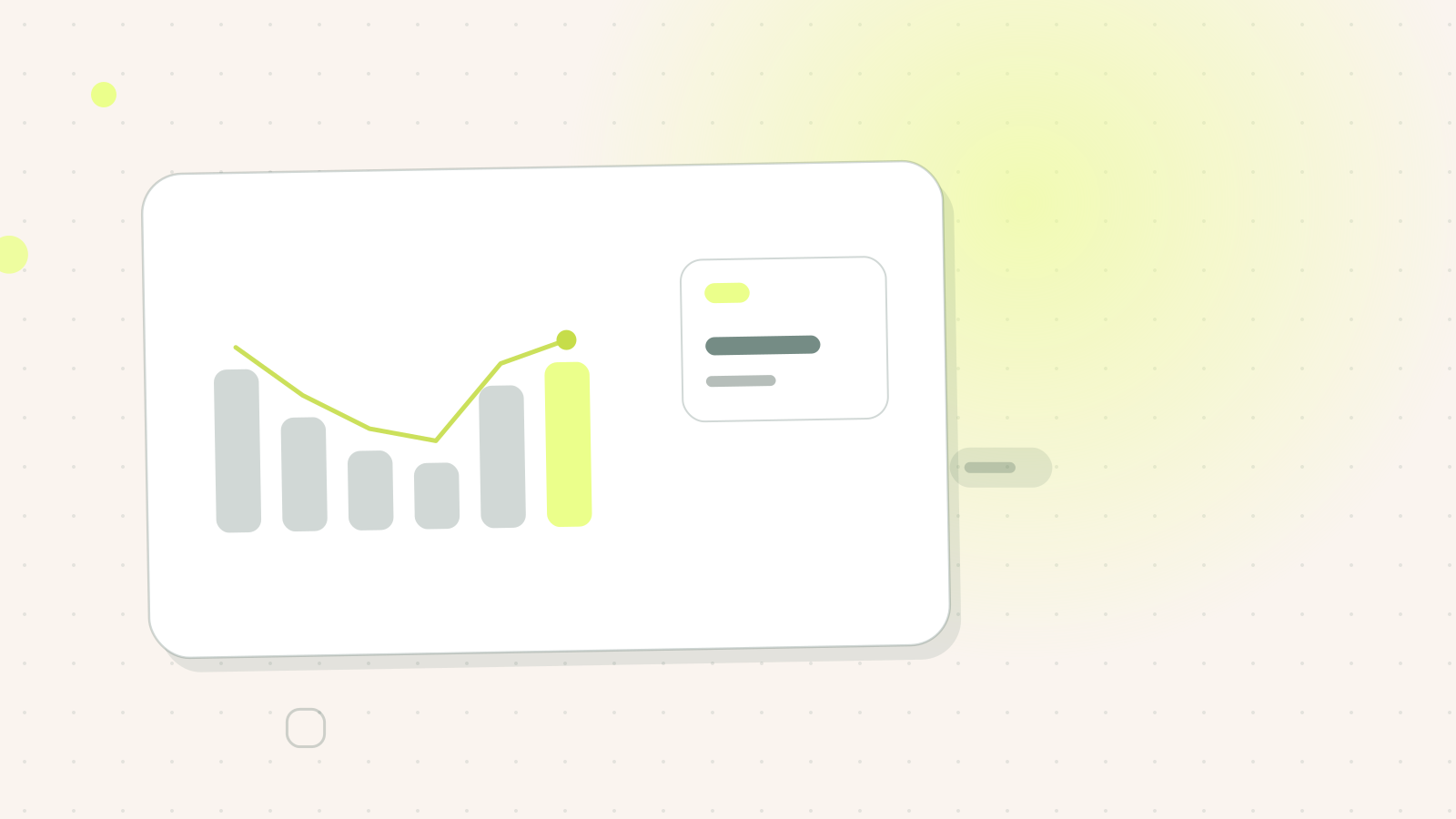
The median net margin of a traditional French restaurant comes down to one figure: 8% in 2025, per Banque de France, Skello and GNI. On €1,000 taken, €80 stays.
On a band that thin, everyone spends their time shaving three points off food cost. That is not where it is decided.
What decides it is the revenue that never reaches the till, and that nobody counts because it exists nowhere. Here are the three leaks, and the report to pull to size them.
Why your margin shrinks even with a full house
Your food cost is locked at 30%. Overheads are under control. Evening covers go out at €45. And yet, at the end of the month, the numbers don't add up.
The reason: the average restaurant misses 18 to 25% of all incoming requests. Reservations, private hire, dietary queries, group bookings. Every missed call is an unsold cover, and an unsold cover means 100% margin lost, not 30%.
- 62% call a competitor (after a missed call)
- 85% never call back (B2C telecoms studies)
- +28% olive oil (2025 inflation)
How many calls is your restaurant missing every month? See how many calls you're losing
The 3 invisible leaks nobody calculates
Your accounts show food cost and overheads. They don't show what never came in.
- Leak #1, off-peak calls. Between 2pm and 6pm, during the break: 22 to 38% of call volume. Nobody answers.
- Leak #2, unmanaged no-shows. 9 to 15% of reservations on average. One missed table of 4 at 7:30pm = €180 in revenue, plus €100 in prepared food.
- Leak #3, group requests. 1 in 2 private hire enquiries never converts for lack of a response within 24 hours. Average spend: €600 to €2,500.
One thing in common: all three happen when nobody is free to answer.
Calculate what the leak is costing you
Run the numbers yourself. They are more revealing than any industry benchmark.
For 80 covers per day at €38 average spend, 20% of missed calls represents roughly €12,000 in monthly revenue that simply evaporates, or €12,160 on the standard assumption. At 8% net margin, that's nearly €1,000 in pure profit, every month. The assumption is deliberately conservative: only half of those missed calls were about a booking.
Run it again with your own figures. Our dedicated missed calls cost calculator cross-references incoming volume, average spend, and off-peak hours.
Estimate your recoverable booking volume
+2 net margin points in 90 days: the method
65-cover bistro, Lyon: net margin 7.2% → 9.6% in 12 weeks
Before Heep: 38% of calls missed during the 2pm–6pm break. No response outside opening hours. Three evenings a week, two or three tables sat empty at 7:30pm despite incoming calls.
- +2.4 net margin points
- 94% calls handled
- €7,200 monthly revenue recovered
Twelve weeks later: missed calls followed up by message, 4% no-shows instead of 11%, a structured group pipeline. The menu did not change, and neither did the prices.
Measure the leak
Pull your operator call log. Count unanswered calls during the break and outside hours. That's your baseline.
Catch the calls nobody picks up
Every unanswered call gets a WhatsApp or SMS message within seconds, whatever the hour. Reservations, menu questions, allergies, group enquiries: the conversation carries on in writing.
Control no-shows
Day-before SMS reminders and card holds for groups. SMS reminders cut no-shows in half.
Convert off-peak demand
The 62% of requests outside opening hours that nobody used to handle become converted bookings.
Why Heep is not a telephone answering service
- No phone menu. A missed call becomes a real conversation by message: nothing to press, nothing to wait for.
- Natively omnichannel. SMS, WhatsApp, Instagram DM, email, web form: one unified thread per customer.
- Connected to your booking system. Zenchef, SevenRooms, TheFork. Live availability read in real time.
- The guest's own language. A tourist who writes in Japanese at 3pm gets their table, in Japanese.
- Structured escalation. Six defined cases where the AI hands over to the team, not one more.
Over twelve months, those three leaks are worth 1.5 to 2.5 points of net margin. The number to go and find this week fits on one page: your thirty-day operator call log, the unanswered column. The rest of the calculation follows from it.
Frequently asked questions
What is the average net margin for a traditional restaurant in 2025?
Between 5 and 10%, with a median around 8%. Fast food reaches 10–15%; fine dining typically stays below 5%. Sources: Banque de France, GNI, Skello.
How many calls does a restaurant miss on average?
20 to 40% of incoming volume according to B2B telecoms studies. In restaurants, the peak is during the 2pm–6pm break and after 10pm. A 30-day operator report is enough to measure it.
Can recovering 50% of missed calls really add 2 margin points?
For 80 covers at €38 average spend, 20% missed calls ≈ €12,000 monthly revenue. Half recovered at 8% net margin gives €480/month, plus the group effect — 1.5 to 2.5 annual margin points is realistic.
Does food cost still matter?
Absolutely. But most serious operators have already optimised it. The 3 invisible leaks, by contrast, aren't tracked by anyone. The short-term ROI on fixing them is nearly always higher.
How long does it take to deploy Heep?
A few days. Number ported or forwarded, scripts adapted to your menu, integrations connected. No commitment required.