Group bookings: how Heep closes a party of 8 in 90 seconds
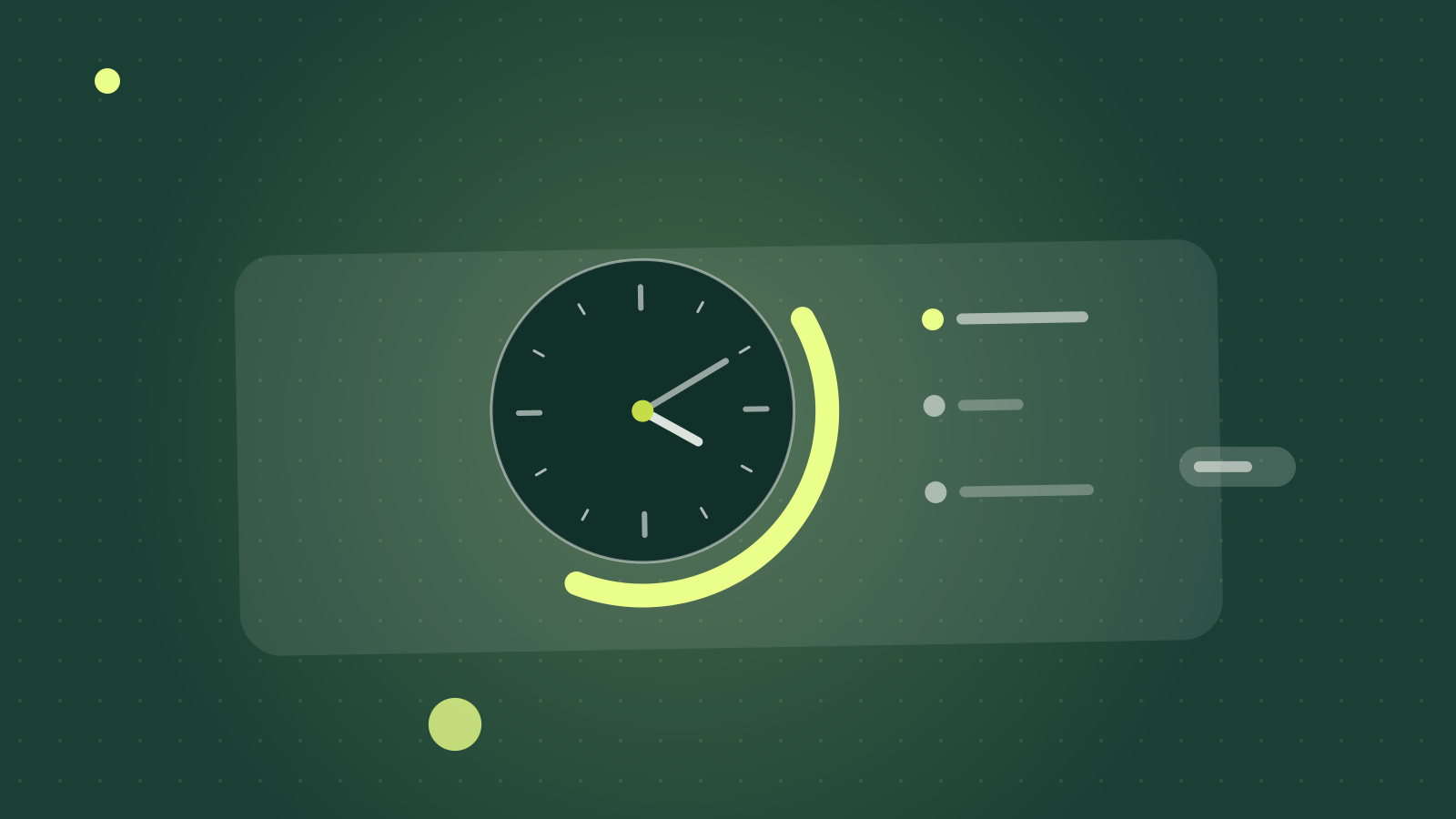
Group enquiries eat 18 minutes of back-and-forth and you lose two out of three tables to a faster reply. Heep qualifies, secures the card hold and confirms in 90 seconds.

"A table of 8 on Friday at 9 pm, two allergies, and they want to know if there is a group set menu." That enquiry arrives on WhatsApp while the pass is sending. It is worth £280, and it asks for eighteen minutes of back-and-forth that service will not give you.
That is the case we designed the group sequence around: not the table of two, but the one with a threshold, a head count that moves and a guarantee to place.
£1,580 in recovered group revenue every week after deploying Heep, average across 14 client brasseries.
Why one in three group enquiries goes unanswered
A group enquiry never lands at the right moment. Tuesday 12.45 pm, you are turning 80 covers. Friday 7.30 pm, the floor is drowning. Sunday 10 pm, you are cashing up.
The guest asks specific things. How many people. Which date. Any allergies. A set menu. A card hold option. You tell them “I’ll call you back”. You forget.
This is not a rare case: 34% of covers served go to groups of 4 or more (European foodservice data, 2024), and 62% of calls and messages outside service hours stay unanswered (observed across the Heep base). A group enquiry costs 18 minutes on average, confirmed or not (observed across the Heep base).
The guest does not wait. They send the same request to three other restaurants. Whoever answers first books the table.
The real cost of a Friday-night party that walks away
Run the maths on a party of 8 on a Friday night.
- £35 Average spend per cover in the evening (UK Foodservice Council, 2024)
- £280 Revenue from a single table of 8 (Excluding additional drinks)
- £58,240 Yearly revenue lost if 4 tables walk away per week (208 parties × £280)
Want the precise number for your restaurant, using your real data? Estimate my recoverable group revenue
90 seconds instead of 30 minutes: what changes in the thread
The usual journey is not thirty minutes: it is thirty minutes spread over three days. A call to voicemail, a call back into thin air, an SMS, an email, a second SMS for the guarantee. Lost two times out of three.
The switch comes down to one thing: the conversation stops breaking into pieces. A missed call recovered by SMS or WhatsApp, an Instagram DM, an email, all land in the same thread. Trade-off: that single thread assumes your channels are plugged in, or an enquiry that lands elsewhere stays elsewhere.
Case study: £5,420 extra group revenue per month
Brighton brasserie, 110 covers. Before Heep: 9 group enquiries per week, 3 confirmed, and an owner who spent every lunch break ringing back. After 6 weeks: 11 enquiries handled out of 11, 8 confirmed with a card hold in place.
- No group enquiry left unanswered
- +£5,420 monthly group revenue
- 0 hours spent ringing back
How Heep negotiates a party without interrupting service
Automatic group detection.
The moment an enquiry mentions 6+ covers, Heep switches to the “group” sequence: dedicated rules, reserved slots, card hold required.
Five questions, in order.
Date, time, exact head count, occasion, allergies. No padding, no callback request. All in one conversation.
Smart slot proposal.
Heep knows your floor plan. It offers the table that maximises covers without blocking the rotations on either side.
Instant card hold.
The card-hold link from your reservation system is sent inside the conversation. Nothing is charged at booking: the card is only debited on a no-show, per your rules. No card hold within 24 hours, slot released automatically.
Direct sync.
Booking pushed to your Zenchef, TheFork or SevenRooms. You never touch a thing.
Three things a web form will never do
- Negotiate the date. A form shows fixed slots. Heep nudges, offers 7.45 pm instead of 8 pm, saves the booking.
- Adapt the offer to the profile. 30th birthday: suggest a drinks menu. Business dinner: offer the private room. A form never asks.
- Lock the booking financially. A form sends an email. The guarantee lands three days later, sometimes never. Heep sends the card-hold link inside the conversation, in 40 seconds.
At the end of that sequence, three settings stay in your hands: the head count that switches on group mode, the one above which the enquiry goes to your sales lead, and the card-hold rule. The defaults are there to be changed.
Go further: the no-show cost calculator, and how Heep replies to every email under one minute.
Frequently asked questions
At what head count does Heep trigger the group sequence?
Six covers by default. You can tune the threshold from 4 to 12 depending on your format and service pressure.
What if the guest insists on dealing with a human?
The conversation is handed to your team straight away, with the full context already captured. You pick it up exactly where it stopped.
Is a card hold always required?
No. You choose: always, only above a revenue threshold, or never. The setting takes 30 seconds.
Does Heep handle full-venue private hire enquiries?
Yes. Beyond the threshold you set (20 covers by default), the enquiry is routed to your sales lead with every detail already qualified.
How long does set-up take?
A few days. You provide the menu, opening hours and house rules. Heep handles the rest, including the connection to your reservation system.