Restaurant marketing 2026: what actually converts (beyond the 19 Instagram ideas)
87% of your guests search online before booking, and 85% of requests arrive outside service hours. Here’s the restaurant marketing that actually converts in 2026.
Two public figures, published months apart, tell the same story, and nobody draws the conclusion: 87% of diners research a restaurant online before choosing one, and 85% of their booking requests arrive outside service hours. You are found. You are not reachable.
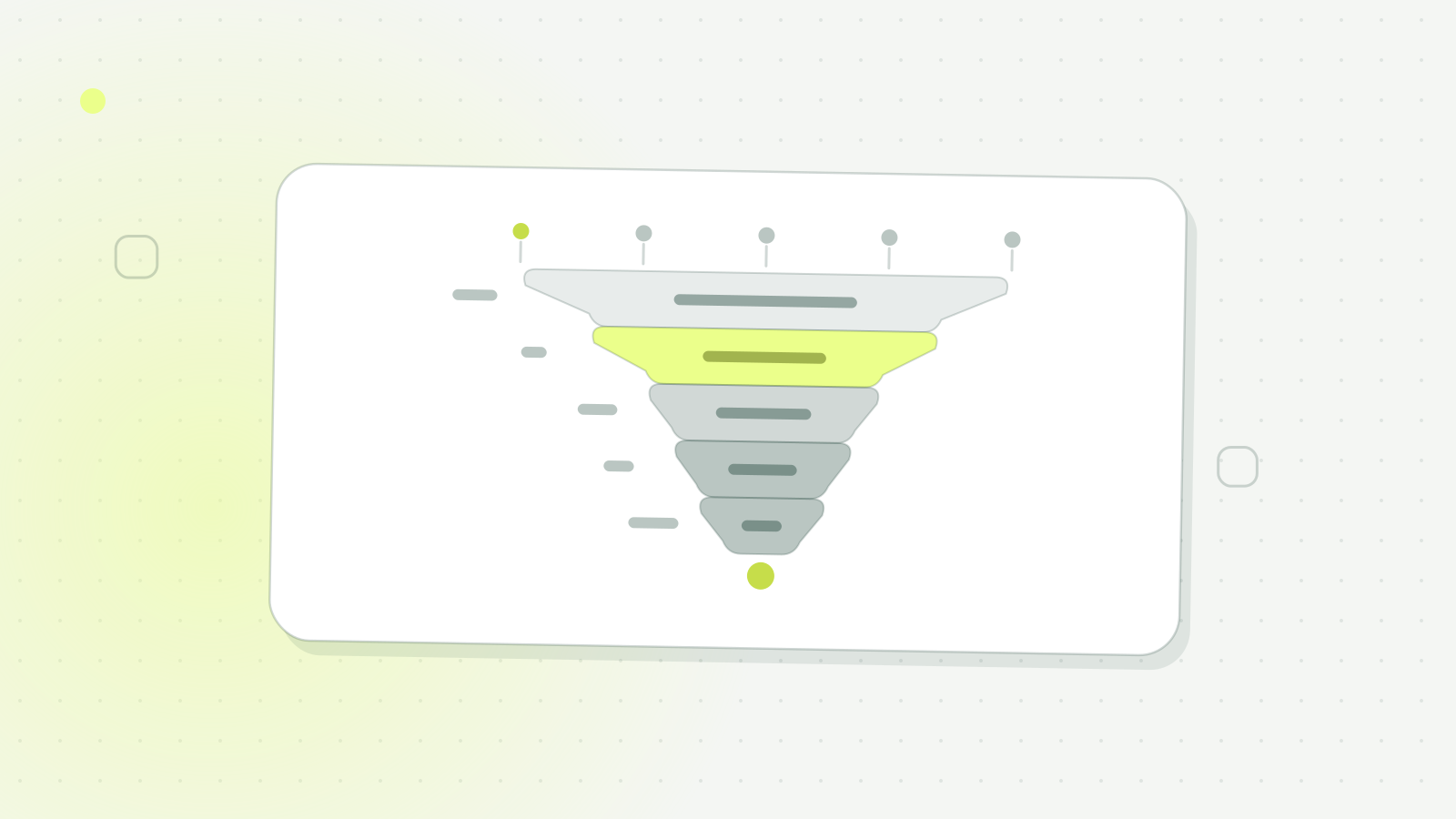
That is the whole problem with restaurant marketing in 2026. The “19 Instagram ideas” guides all work the top of the funnel, where competition is most expensive, and they are a decade behind on where it actually jams. The bottleneck has moved. It now sits a foot away from the table.
87% of guests search for your restaurant online before walking in, and 85% of their booking requests arrive outside service hours. Your marketing stops where your phone stops answering.
Why the classic definition of restaurant marketing is failing you in 2026
Open any “Top 19 restaurant marketing ideas”: Instagram, loyalty, events, Google Ads, email. All true. All too early.
These guides treat marketing as an attraction machine, and that machine works. Which is exactly what makes the other end of the funnel so expensive: every euro spent at the top produces one more request at the bottom, at 10:40 pm on a Sunday, when there is nobody to take it.
Three numbers, with their sources, are enough to make the diagnosis.
- 87% of French diners research a restaurant online before booking (Tool-advisor, French restaurant industry figures 2026)
- 85% of booking requests arrive outside service hours (18% between 10pm and 10am) (Zenchef, The online booking revolution)
- +20-45% average footfall increase over 6 months for restaurants with a structured digital strategy (Be-Hype, Digital restaurant marketing 2026)
So this isn’t a visibility problem. It’s a response problem. Every unanswered after-hours request sends your Instagram budget straight to a competitor.
The 5 channels that actually bring in covers (and the ones you list for nothing)
The ranking below uses one measure only: cost of acquisition per cover actually seated. Not per click, not per view, not per reach. For a 40-80-cover neighbourhood restaurant, the order runs like this.
- Google Business Profile, 1,200 actions/month on an optimised listing, ~3% conversion to booking. Marginal cost: £0. Why Google visibility alone won’t fill your tables.
- Instagram DMs, not the feed, the DMs. Typical monthly volume: a few dozen messages. Answered within minutes they convert; answered the next day they barely do. Turn your Instagram DMs into bookings.
- WhatsApp Business, 98% open rate. The most cost-effective anti-no-show channel. Cost: €0.05/message.
- Transactional SMS, confirmation, D-1 and D-2 reminders. Reduces no-shows by 30-60%.
- Google Reviews, every half-star above 4.2 adds ~12% more clicks. Going from 4.2 to 4.6 stars in 90 days.
What you can stop listing: TikTok for a neighbourhood bistro without an existing community, letterbox flyers, local sponsorships without QR codes or tracking. Not bad channels, just channels nobody can tie to a single seated cover.
And the same budget produces two opposite outcomes depending on what happens after the click. Without a conversion layer: after-hours requests land in voicemail, the Sunday evening DM is read on Monday at 2pm, 23% of messages turn into bookings, and each cover costs €18-25. With a reply in under a minute, on every channel, at any hour: the Sunday 10pm DM becomes a table confirmed at 10:01pm, 81% of messages turn into bookings, and the cover drops back to €5-7. Identical ad spend in both cases.
Case study · 60-cover bistro · Paris 11th
€1,200/month in marketing, +245% conversion at zero extra spend
A 60-cover Parisian bistro, €1,200/month of marketing budget split between Instagram and Google Ads. Before: 3,200 monthly views produced 47 DM enquiries, of which only 11 were handled in time. Conversion rate: 23%.
After adding a conversational layer connected to Instagram and WhatsApp: DMs get a reply in under a minute, and the same volume of messages produces markedly more bookings. No extra acquisition spend at all: this is conversion, not traffic.
- 47 messages / month
- 11 → 38 bookings
- +245% conversion
Run the numbers on your own figures: your message volume, your real response time, your average spend. See how many bookings you’re losing
The missing layer: turning curiosity into a booking, 24/7
Every 2026 guide lists the channels. None describe what happens between “I saw your Reel” and “I have a table on Saturday at 8pm”. Yet that gap of a few minutes is where a booking book fills up or empties out.
That layer is the agent listening on Instagram, WhatsApp and SMS at the same time, following up by message on the calls nobody could take, qualifying the request (date, party size, allergies), checking availability and confirming, in English or in French, at 11pm on a Sunday.
Connecting it requires no migration: you link the existing accounts, the agent learns your menu and opening hours, then its replies run alongside your team for a few days before you hand it the room. Count a week, not a quarter.
Measuring it: 3 restaurant marketing KPIs that predict a full booking book
Forget likes, followers, impressions. Three indicators are enough, and all three can be worked out by hand, with no extra tooling.
KPI 1. Response rate under 5 minutes, across all channels. Beyond 5 minutes, conversion drops by around 50%. The 2026 marker: over 95% of messages handled in under a minute. Below that, your marketing is funding your competition.
KPI 2. Cost of acquisition per seated cover. Not per click, not per booking: per cover actually served. Healthy range: €5-10. Above €18, it’s the mix that needs rebuilding, not the budget that needs raising.
KPI 3. Share of after-hours requests captured. Out of 100 requests received outside service, how many become confirmed tables? Without a conversational layer, most of them are simply never answered. With one, the question becomes how many you convert, not how many you read.
Pull those three numbers for the month just gone. If your under-5-minute response rate sits below 50% and your cost per cover is over €18, you don’t have an ad budget problem: you have an opening-hours problem on your inbox. Over twelve months, at constant spend, that is the gap between filling your room and filling the one next door. The figure to go and find this week is a simple one: how many requests arrived outside service, and how many got an answer before the next morning.
Frequently asked questions
What marketing budget does a restaurant need?
For a 40-80-cover establishment in an urban area, budget €800-1,800/month in year one (geo-targeted Google Ads, Google Business Profile, professional photography, occasional social ads). The classic mistake: spending it all on acquisition. The 2026 rule: 60% acquisition, 40% conversion & retention (AI conversational layer, SMS reminders, review programme).
Do you need to pay for Instagram ads to bring in customers?
Boosting a local Reel (€5-15/post) can generate 200-800 qualified views. But the money only has value if the DMs it generates are answered in under a minute. Without a 24/7 response layer, you’re paying for messages you’ll read Monday morning, when the guest has already booked elsewhere.
How do you measure restaurant marketing ROI?
The only honest equation: (revenue from new guests − total marketing cost) / total marketing cost. The trap: counting only clicks. The right method: a booking source code per channel (UTM + “how did you hear about us?” at reservation) and a monthly calculation over a rolling 6-month window.
When does a restaurant need an AI agent for its marketing?
As soon as you receive more than 30 inbound messages per month across all channels (Instagram DMs, WhatsApp, Google Business, phone). Below that, good organisation is enough. Above it, you’re statistically leaving 60-75% of your conversion on the table.
What does an optimised Google Business Profile earn a restaurant?
An optimised listing (pro photos, up-to-date hours, weekly posts, active Q&A, > 4.4 stars) generates an average of 1,000-1,500 actions/month (calls, directions, site clicks). For a neighbourhood bistro, that’s 25-60 bookings per month directly attributable, or €1,800-4,500 in additional revenue.