Restaurant Deposits in France: What the Law Actually Allows in 2026
Deposits, prepayments or card holds: what French law lets restaurants claim against no-shows, and how to recover up to 20% of lost revenue.

"Are we actually allowed to charge them?" That's the Monday morning question, usually after a Saturday night with three empty tables.
The short answer is yes. French law lets you take a guarantee, in three different forms. The long answer is in the drafting: shaky T&Cs protect nobody on the day a customer disputes the charge.
20% of monthly turnover lost by restaurants without a no-show policy (TheFork study, premium segment).
Why one in five bookings costs you money
A no-show isn't a service accident any more. It's a loss line, like breakage. TheFork puts the range between 5% and 20% of turnover, depending on the segment.
The logical reaction is to ask for a guarantee. Four restaurateurs out of five don't dare. Fear of losing the booking. Fear of the unfair clause. Fear of the bad review next morning.
So they absorb it. And they pay twice: the empty cover, plus the one they turned away that same morning.
The real cost of a no-show, in numbers
A 100-cover restaurant, €30 average ticket, 10% no-show: €1,000 a week. Over twelve months, €52,000. A full loaded salary, or your entire net margin.
And a plain D-1 SMS reminder combined with a card hold prevents roughly 40% of no-shows.
See our no-show cost calculator to size your exact exposure.
Want to size your real exposure in 2 minutes? Simulate your lost revenue
Deposit, prepayment or card hold: the only law that matters
Three words everyone uses as synonyms. Three legal regimes. Pick the wrong word in your T&Cs and you've written an unfair clause, which means an unenforceable one.
Arrhes (default regime)
Either party may walk away.
Customer loses the sum if they cancel. You refund double if you cancel. Legal presumption, Article L. 214-1 of the French Consumer Code: write nothing and this is the regime you get.
Acompte (firm deposit)
Binding commitment on both sides.
Customer must pay the balance even if they cancel. You must deliver the service. Spell it out in the T&Cs, or a judge reclassifies it as arrhes.
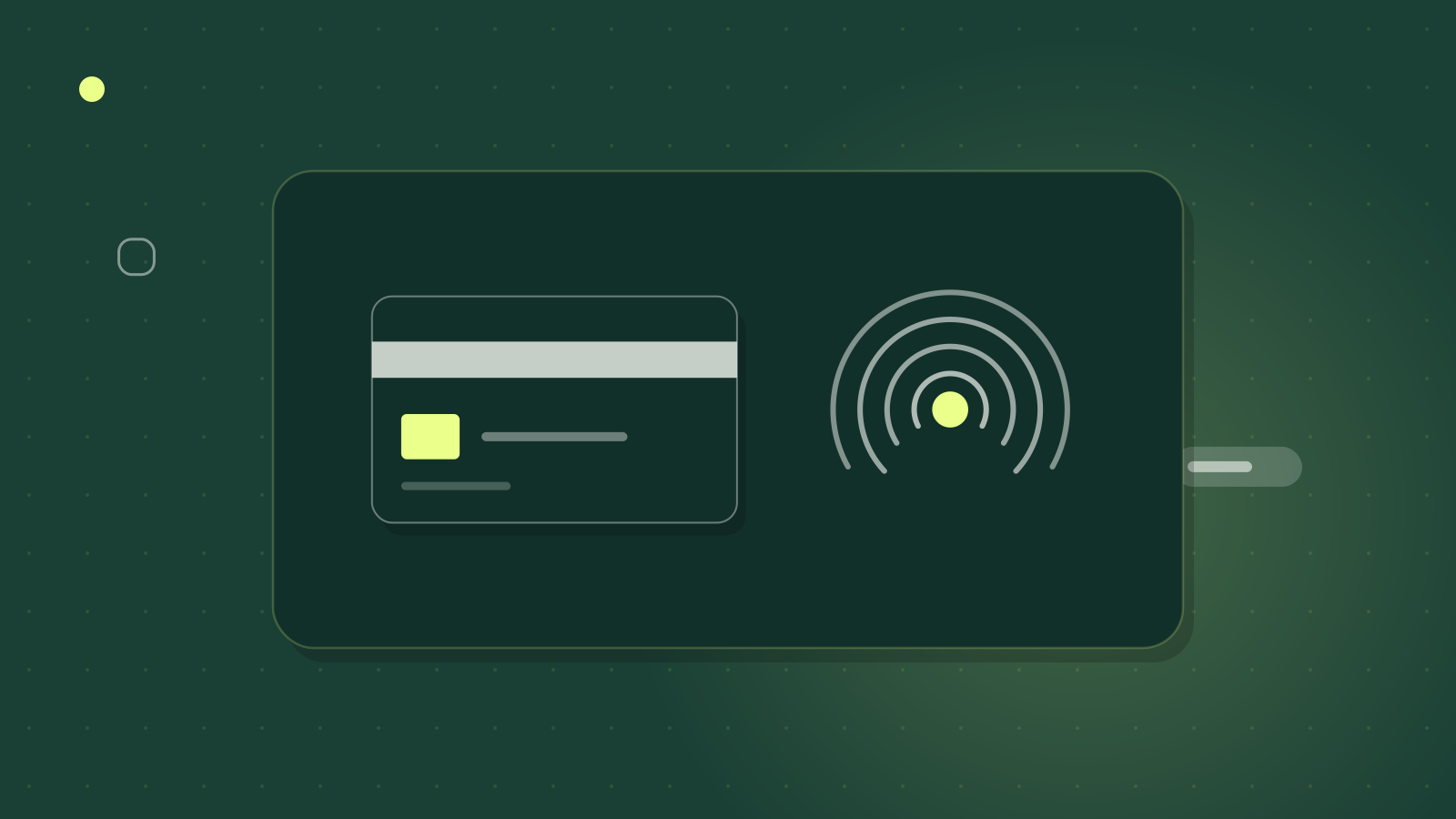
Third option, the one I see most in high-end venues: the card hold (empreinte bancaire). You ring-fence an amount on the card without debiting it. They show up, nothing is charged. They don't, you charge what your T&Cs allow.
Four points to hold, and they hold together or not at all.
- A card hold isn't a payment. Ring-fenced for 5 to 7 days maximum on the customer's account.
- The amount is disclosed upfront. Without written, accepted notice, the pre-authorisation can be challenged.
- No asymmetric clause. T&Cs without a reciprocal refund are unfair: settled case law.
The fourth is the one people forget: acceptance happens at booking time, never after, with a timestamped trace.
Case study: -73% no-shows in six weeks
A Parisian bistro, 80 covers, down from 14% to 3.8% no-show in six weeks. The setting fits on one line: card hold for parties of 4 and above, €25 per cover, announced by SMS at confirmation. No charge for guests who turn up.
- -73% No-shows
- +11% Friday-Saturday revenue
- 0 Customer complaint
What works isn't the charge: it's the prospect of it. The guest cancels instead of vanishing, and you get the cover back while it's still sellable.
See how Heep automates the whole flow
Roll out a legal guarantee in 30 days
Pick the regime
Card hold above 4 covers: least friction. Firm deposit for tasting menus. Arrhes if you want to keep flexibility.
Draft symmetric T&Cs
If the customer can cancel, so can you, and the reciprocal refund must be in writing. Otherwise: unfair clause.
Communicate before validation
By phone, SMS, on the site: the guest sees the amount and accepts before confirming. Never a surprise afterwards.
Trigger a D-1 reminder
The reminder SMS cuts no-shows by 40%, without capturing anything. Start there if you're hesitating.
Measure three numbers
No-show rate, D-1 cancellation rate, recovered loss. Without them, you're flying blind.
How Heep captures the card hold without friction
Legally, the card hold is the safest option. Operationally, the most tedious: link to send, T&Cs to get accepted, trace to keep. The kind of job nobody does on a Friday night.
Heep sends the pre-authorisation link by SMS right after the booking is taken, whether it came from the phone, the site or WhatsApp. The guest taps, validates, twenty seconds. The T&Cs are shown before validation and the acceptance timestamped: that's your file if they dispute it. The D-1 reminder goes out in the guest's own language, with a one-tap cancellation link, because a D-1 cancellation suits you. And if nobody shows, the agreed amount is charged by your payment provider, per your T&Cs.
Restaurants deploying Heep with a card hold see on average 60 to 75% fewer no-shows by the second month.
If you do one thing at tomorrow's open: reread your T&Cs and look for the reciprocal refund sentence. Until it's in there, the rest doesn't hold. Only then pair it with the no-show calculator to size the recovery.
Frequently asked questions
Can a firm deposit be charged at booking time?
Yes, provided the sum is clearly labelled as a deposit (not as arrhes) and the T&Cs include symmetric cancellation rights. Otherwise, French case law reclassifies it as arrhes, and the customer can withdraw.
Is a card hold a payment?
No. It's a temporary ring-fencing of the amount on the customer's account. No actual debit until a no-show is confirmed. Maximum duration: 5 to 7 days depending on the issuing bank.
What if the customer disputes the charge after a no-show?
If your T&Cs are clear, symmetric and explicitly accepted before booking, you are protected. The timestamped acceptance trace (SMS, email, web form) is the cornerstone of your defence.
How much can be ring-fenced on the card?
Free, but reasonable and disclosed upfront. Common practice in France is €20 to €30 per cover. Above that, you risk the unfair-clause doctrine unless the service justifies it.
Does asking for a card hold scare customers away?
Marginally. Studies converge: less than 5% additional booking abandonment, easily offset by the drop in no-shows. Regular customers understand and accept it without friction.