SevenRooms: 7 Underused Features That Drive +20% Revenue at Your Restaurant
SevenRooms: 7 underused features most restaurants miss — auto-tags, lifecycle emails, shift constraints, two-way SMS. Practical guide for 2026.

We get asked a lot whether SevenRooms is worth the money. The question is framed wrong. A booking diary is cheap; a guest memory is not, and SevenRooms is the second one. That is why you find it at MGM Resorts, Hilton and Wynn. The question that matters is what you have switched on inside it. Across the venues we see connected to it, the answer sits around 30%. Here are the seven features that justify the subscription, and the one limit no configuration gets past.
+22% average revenue lift on restaurants moving from “basic SevenRooms” to “fully configured SevenRooms + unified inbound channel”. The difference doesn't come from the software: it comes from the data that gets in.
SevenRooms in brief: who it's for
SevenRooms is a reservation, guest CRM and marketing automation platform built for restaurants and hospitality groups. Founded in New York in 2011 and acquired by DoorDash in 2023, it now powers tens of thousands of venues including MGM Resorts, Wolfgang Puck, Hilton, Marriott and many premium European groups.
What separates it from OpenTable, Resy, Zenchef or TheFork fits in one line: the others keep a diary, SevenRooms keeps a file. It builds an unusually rich profile per guest (allergies, favourite dishes, preferred table, lifetime value, frequency) and fires marketing and operational scenarios off that data, provided somebody took the time to write those scenarios.
- 13K+ venue clients across 250+ cities (SevenRooms, 2025)
- 2 bn guest profiles managed on the platform (SevenRooms, 2025)
- +30% average lift in repeat business once SevenRooms automations are turned on (SevenRooms case studies, 2024-2025)
SevenRooms is expensive: several hundred dollars per month per venue, plus onboarding fees. The bet is that the data captured easily justifies the cost. Provided the data gets in.
Using SevenRooms but unsure what's slipping through the cracks? Find out what you're leaving on the table
The 7 underused features
Seven functions already included in your subscription, from the quickest to switch on to the most structural.
Behavioural auto-tags
SevenRooms automatically tags your guests by behaviour: “big spender”, “repeat 5+”, “birthday celebrant”, “late canceller”. Your floor managers see those tags directly on the reservation, in service.
Default setup covers 4 to 5 tags. Take it to 12 and use them to drive seating and special touches.
Enriched guest profiles (manual notes + history)
Every conversation, every preference (“fish, no skin”, “favourite bottle”, “anniversary May 14th”) belongs in the guest note. That database becomes your number one asset: it travels between shifts and survives staff turnover.
Simple rule: any detail mentioned more than twice goes on the profile. The winter evening server should know what the guest was drinking last summer.
Lifecycle auto-emailing
SevenRooms triggers automatically: post-visit email D+1, win-back at D+90 if no return, anniversary message 7 days out, win-back at D+180. Each scenario can be customised by segment (VIP, first visit, group).
Venues that activate all four lifecycle scenarios see on average +18% returns at 12 months. Marginal cost: zero.
The shift planner with operational constraints
Set complex rules per service: “no more than 2 tables of 8 in the evening”, “19h pre-set for early seatings”, “cap 70% occupancy at 21h to preserve walk-ins”. The system automatically refuses bookings that violate the rules.
Most venues use it as a plain diary. Switch the constraints on and you remove most of the manual seating calls.
Two-way SMS messaging
You can text a guest from SevenRooms (“your table will be ready at 21h05”) and receive their reply in the same thread, archived on their profile. Available, and very often never switched on operationally.
Useful above all for same-day confirmations and last-minute changes. Mind the trade-off: if nobody watches the thread during service, you have opened a channel nobody reads.
Buyouts & private events workflow
SevenRooms has a dedicated module for buyouts: e-contract, card deposit, pre-selected menus, automatic BEO. Most restaurants still handle privatisations by email and an Excel sheet.
At a venue with 4 to 6 buyouts per month at €2,000+ average ticket, the module pays for itself on the first event handled cleanly.
Cover flow and covers in seat
SevenRooms distinguishes covers booked, covers arrived and covers in seat at any moment. Combined with average dwell time, this lets you predict to a 30-minute window when you can take a walk-in without breaking service rhythm.
Plenty of houses leave the host to guess it. It is computed in real time, and it is on the screen.
Using SevenRooms and wondering what you're leaving on the table? Book a free audit
The blind spot: SevenRooms can't see what doesn't arrive
That limit is not a configuration problem. SevenRooms handles what is inside your system very well. It never sees what tries to get in and never makes it.
What SevenRooms sees
- Direct widget bookings
- Reserve with Google bookings
- Manual phone entries
- Walk-ins logged by the host
What SevenRooms doesn't see
- Instagram DM unanswered at 7:45pm
- WhatsApp message ignored on Sunday evening
- Group email buried among 40 in the inbox
- Missed call during the dinner rush
At an 80-cover restaurant receiving roughly 60 inbound requests per day across all channels, an estimated 20-30% never reach SevenRooms. Not because the system is bad: because those requests arrive through channels nobody watches mid-service. A guest profile only fills up with the conversations that reach it.
Case study — Noto Paris (Moma Group)
- Setup: SevenRooms as the booking engine, Heep as the multi-channel inbound AI layer.
- Outcome: 1,600+ confirmed bookings per month pushed straight into SevenRooms, including 2,500 missed calls recovered by message and 1,300 multi-channel conversations handled by AI.
- Effect on SevenRooms data: +30% enriched guest profiles (each AI conversation updates the notes), so marketing automations get more accurate over time.
- Full breakdown: the Noto Paris case study.
How to connect SevenRooms to your inbound channels
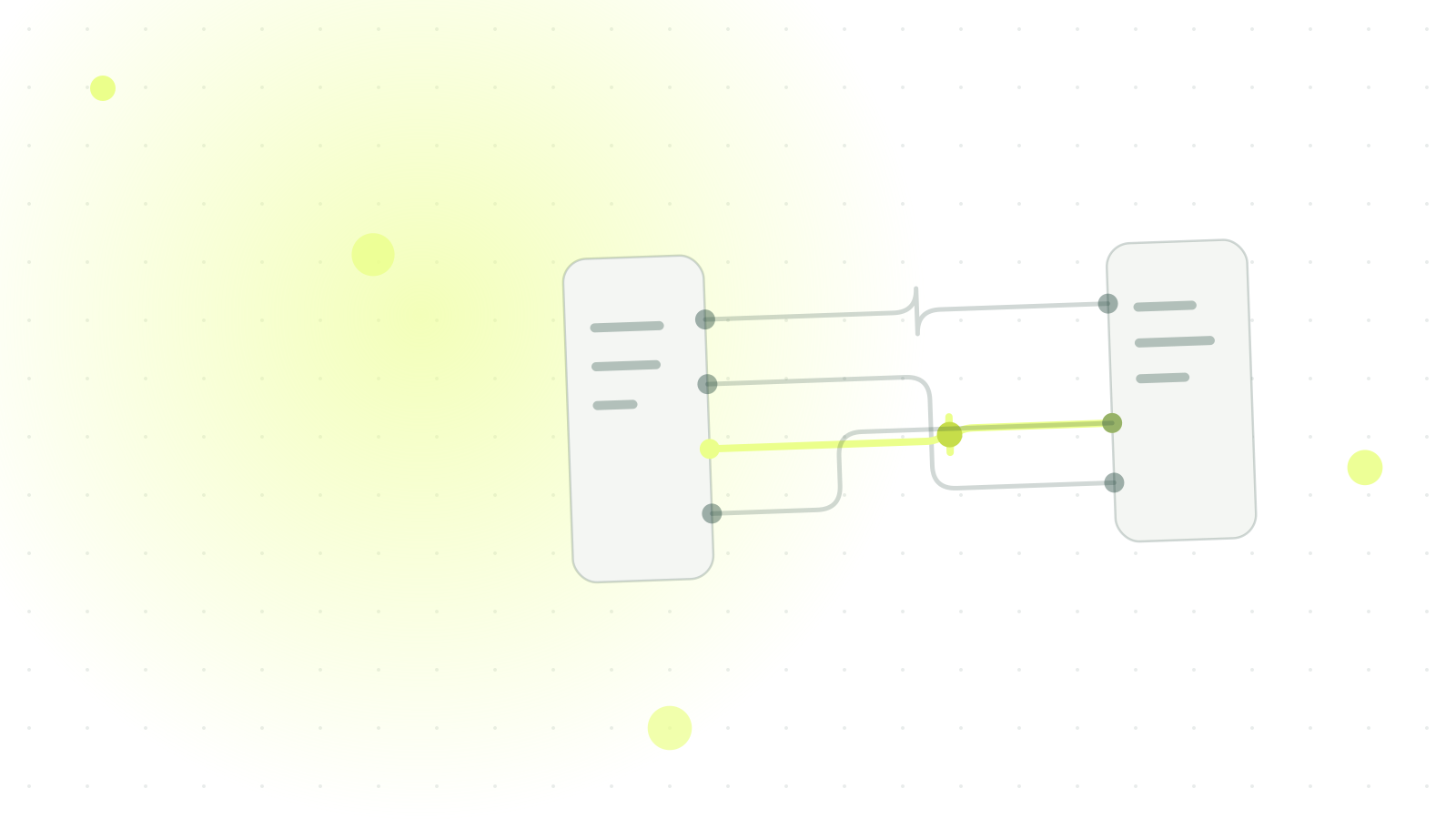
The point isn't to replace SevenRooms, but to make sure every request reaches it, whichever channel it came through.
- Native SevenRooms API connection. Heep creates, modifies and cancels reservations directly inside your SevenRooms. Zero double entry, zero CSV export.
- Unified multi-channel inbound. WhatsApp, Instagram DM, Messenger, SMS, email: every channel is intercepted, qualified, and resolved into a SevenRooms booking or a human handoff. A call nobody could take is followed up on WhatsApp, then by SMS if WhatsApp cannot deliver.
- Automatic profile enrichment. Every conversation Heep handles updates the SevenRooms guest record: dietary preferences, occasion, source, language spoken.
- Operational rules respected. Your shift constraints, blackouts, group policy: the AI knows them and applies them before writing into SevenRooms.
- Native multilingual. The main tourist languages are supported, which matters for the international clientele that is the SevenRooms-typical profile.
One condition before you commit: access to the SevenRooms API depends on your region and your contract tier, and the widget on its own is not enough. Get it confirmed in writing that the API is open on your account before you schedule anything.
See also: the same logic applied to Zenchef, how Heep works end-to-end, or the recoverable revenue calculator.
Frequently asked questions
Is SevenRooms a fit for an independent restaurant?
The cost-benefit becomes attractive at high average ticket (€60+) or volume of 1,000+ covers per month. Below that, Zenchef or TheFork Manager are usually better suited.
Does SevenRooms replace a POS like Lightspeed or Toast?
No. SevenRooms focuses on reservations, CRM and marketing. For tills and kitchen, you keep your POS. The two can integrate.
How long to activate every automation?
2 to 4 weeks for a complete rollout including lifecycle scenarios, custom auto-tags and shift constraints. SevenRooms provides a dedicated onboarding.
Does Heep work with SevenRooms from day one?
Yes. The SevenRooms API integration is native. Connection takes a few days, no technical work on your side.
Does Heep actually write to the existing SevenRooms guest profile or create parallel records?
Heep writes directly to the existing profile (matched by phone or email). If the guest is new, a profile is created in SevenRooms with source “Heep” for tracking.