Restaurant reservation KPIs: the 7 invisible numbers worth 18% of your revenue
Food cost, labour, average ticket: your P&L measures everything except what costs the most. Here are the 7 reservation KPIs nobody tracks — plus a built-in calculator to estimate your invisible revenue in 30 seconds.

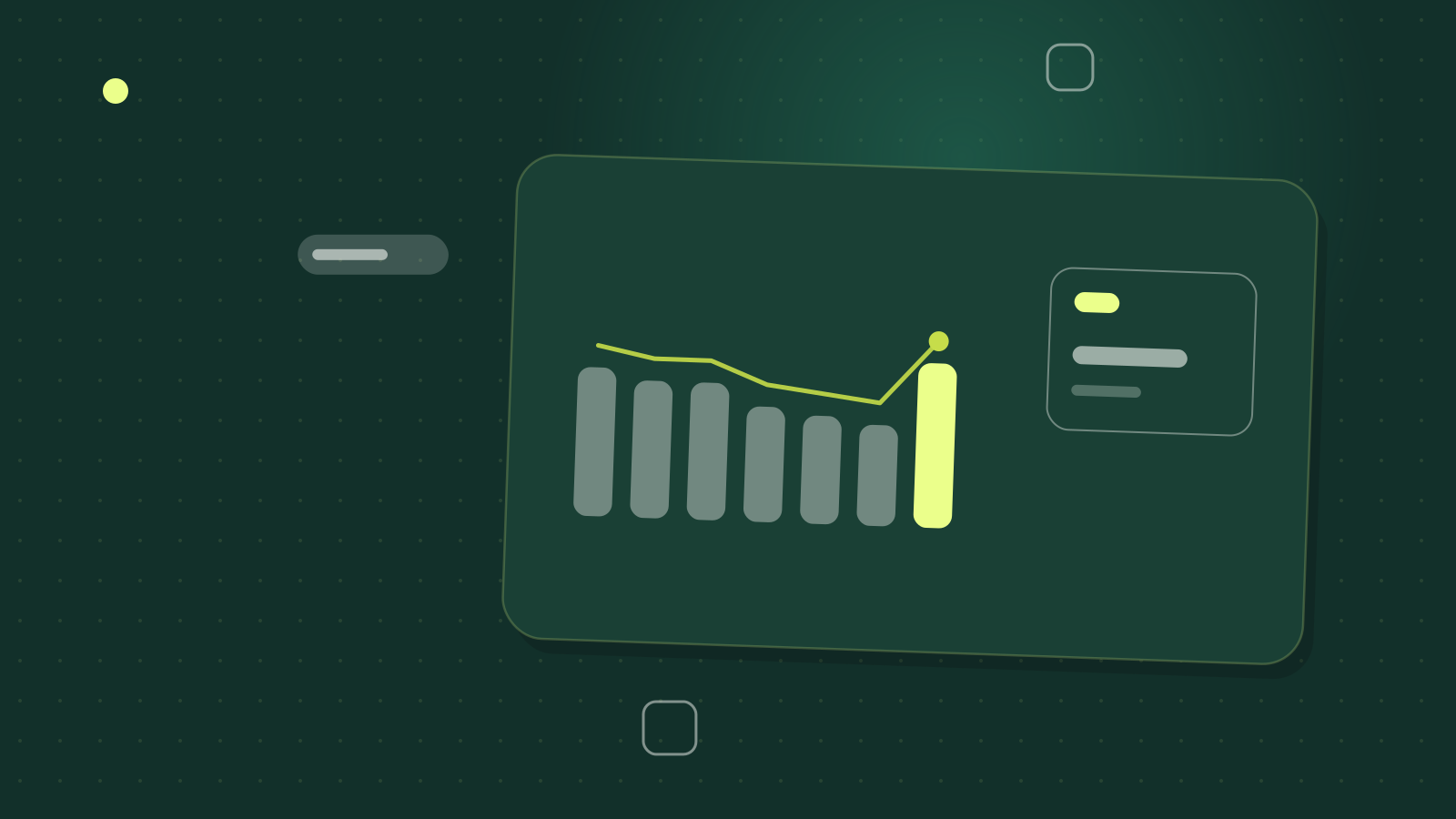
A metric does not exist because someone gave it a name: it exists when something writes it down, every time. Your food cost is written by your invoices, your average ticket by your till. Lost demand is written nowhere: the event that produces it is the one where nobody keyed anything in. Hence these 7 KPIs, worth up to 18 % of your revenue and present in no standard dashboard.
18 % Share of revenue sleeping in uncaptured demand, unrecovered no-shows and badly used time slots in a typical European restaurant.
Why your P&L KPIs lie to you
Food cost, labour ratio, average ticket, prime cost, occupancy. These 18 classic KPIs measure what leaves the kitchen. Not what never enters it.
- The unanswered call — no KPI counts it.
- The Instagram DM sitting for 4 hours — no KPI counts it.
- The 5 pm cancellation that could have been re-booked — no KPI counts it.
- The disputed no-show you never charge — no KPI counts it.
On a restaurant turning over £700K, the observed range is £85K to £130K of invisible revenue. Three leaks feed it, only two measured by a third party.
- 18 % Phone enquiries lost (When there's no immediate answer (Dexem))
- 82 % Bookings made off-shift (When nobody is there to answer (Overfull))
- −42 % No-shows preventable (With well-calibrated automatic reminders)
Want to know how much your restaurant is really letting slip? See how many calls you're missing
The 7 invisible numbers to track
Each of these KPIs takes less than 5 minutes to compute, no proprietary tool required. The target shown applies to an independent doing 150–300 covers per day, to be recalibrated site by site across venues.
Enquiry capture rate
Enquiries handled ÷ enquiries received (calls + DMs + email + walk-ins). Target: > 85 %. Below 70 % you're losing the equivalent of one service a week.
First-response time
Minutes between enquiry and first reply. Target: < 3 min, 24/7. Past 10 minutes, 1 in 3 customers has already called a competitor.
Call-to-booking conversion
Handled calls that become a confirmed booking. Target: > 55 %. Reflects the quality of call handling (real availability quoted, alternatives offered).
Effective no-show rate
Confirmed minus arrived, on a 28-day rolling window. Target: < 8 %. At 12–15 % you're over-booking to compensate — and paying in reviews.
Late-cancellation recovery rate
Tables re-booked within 30 minutes of a cancellation. Target: > 40 %. The most profitable KPI on the list: every point gained is pure revenue.
Channel mix
Split between direct / OTA / phone / DM. Target: > 50 % direct. Below 30 % TheFork dictates your margin.
Effective hour coverage
Share of hours when an enquiry can get a reply. Target: 100 %. Most restaurants run at 28–35 % (service hours only).
Before / after reservation reporting
Before: paper book, scattered TheFork exports, no-shows guessed « by feel ». After: all 7 KPIs in one place, anomalies visible within 24 hours, Thursday night no longer a guess.
Estimate your invisible revenue (30 sec)
How much is your restaurant leaving on the table?
Take one month of enquiries, subtract the ones that got a reply: what remains is uncaptured demand. Multiply by your usual conversion rate, then by your average check, on 26 open days.
That amount is not recoverable in full: count on 60–75 % with 24/7 capture and well-calibrated reminders. That is an assumption, not a measurement.
Model your target capture rate with Heep
Case study: +17 % covers in 60 days
Paris brasserie, 220 covers/day, +17 % covers in 60 days
Before: a capture rate that lets one enquiry in three slip, a double-digit no-show rate, almost no late cancellation recovered, weekly Excel reporting. After KPI tracking and 24/7 capture: all three lines move the right way, and above all they become readable every Monday. How many points you gain depends on where you start, which is exactly why you record it before you begin.
Excel vs real-time reporting
Most operators track these KPIs « when they have time », which means never. Three differences between a monthly Excel and a real-time dashboard.
- Latency — Excel: 7 to 30 days to spot a drift. Real-time: alert within 24 hours.
- Granularity — Excel: weekly aggregate. Real-time: per service, per channel, per time slot.
- Action — Excel: observation. Real-time: you pull the lever (SMS reminder, opened slot) before the next service.
To go further on each channel, explore the Heep blog for SMS, WhatsApp Business and direct booking deep dives.
Before wiring anything up, check two conditions: that every channel you want to count is actually connected, and on what basis revenue is computed. Real through Zenchef connected to Lightspeed, an average-spend estimate everywhere else.
Frequently asked questions
How long does it take to set up these 7 KPIs?
By hand on Excel: 3 to 5 hours of initial setup, then 30 minutes a week of input. Through an automated tool: a few days to connect phone, OTA and DM channels, then everything updates on its own.
If I only track one KPI, which one should it be?
Late-cancellation recovery rate. It's the most profitable: every table re-booked within 30 minutes is pure revenue, no acquisition cost. Target above 40 %.
Does the no-show rate vary by restaurant type?
Yes. Neighbourhood bistro: 6–9 %. Fine dining with card hold: 2–4 %. Central touristy brasserie: 12–18 %. The target moves, the measurement and reduction strategy stay the same.
Does Heep track these 7 KPIs natively?
Yes, plus a dozen more (channel latency, escalation rate, enquiry reasons, hour mix). The dashboard is consolidated in real time and available on mobile.